The Clean Air Program certifies that a product meets low VOC standards and enables companies to communicate that their products support healthy indoor air quality.
What are VOCs?
Volatile organic compounds (VOCs) are a variety of chemicals that are emitted as gas from certain solids and liquids, some of these chemicals have short- and long-term negative impacts on health (EPA).
What emits VOCs?
Thousands of products emit VOCs including cleaning products, paint, personal care products, adhesives, varnishes, stains, cushions, and many more (American Lung Association).
Are VOCs harmful?
Yes, VOCs can be harmful, but the level impact depends greatly on the concentration and the length of exposure. Immediate impacts can include irritation to the eyes, throat and nose, dizziness, fatigue, and nausea. Long term impacts can include liver damage, increased risk of cancer and hypertension. (EPA, NIH)
What is the difference between VOC content and VOC emissions?
VOC content is a measure, by weight, of the volatile compounds contained in product, while VOC emissions determines the type and amount of VOCs released from the product into the surrounding air during use, providing a more direct measure of airborne exposure to the people living or working within the space.. More information here. Clean Air certification is based upon the VOC emissions, which aligns with the newest version of LEED (v5) for which points are award on VOC emission, not VOC content basis.
Do I need VOC testing for LEED or WELL?
Points are awarded in LEED and WELL building certifications for using products that have verified low-VOC emissions, such as Clean Air certified products. LEED, the most widely used green building rating system, and WELL, a building standard focused on human health, award points for using third party certified low-VOC products, like Clean Air, to help ensure a health indoor environment. Getting Clean Air certification for your product can make it more likely your product will be chosen for use in a LEED or WELL certified building, especially since we work with third party data aggregators to get certified products more easily accessible to architects making product selections.
Which test standard applies to my product?
There are two main standards for verifying that products have low VOC emissions:
- For furniture products: ANSI/BIFMA M7.1 for furniture (or Standard Test Method for Determining VOC Emissions From Office Furniture Systems, Components and Seating)
- For building products: CDPH 01350 building products (or Standard Method for the Testing and Evaluation of Volatile Organic Chemical Emissions from Indoor Sources Using Environmental Chambers Version 1.2). To learn about the release of CDPH v1.3 see here.
A table of the conformance criteria for CDPH SM v1.2 and ANSI/ BIFMA sections 7.6.1, 7.6.2. and 7.6.3 can be found here
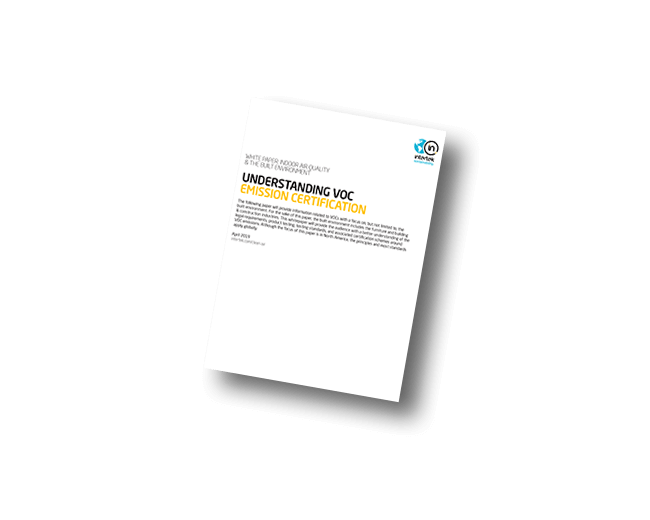
Learn about VOC emission standards for furniture and building products in North America. Discover legal requirements, product testing, standards, and certification schemes in our complimentary white paper, promoting sustainability and safety.
What is Intertek’s Clean Air Certification Program?
Intertek’s Clean Air Certification verifies that products are low-VOC products by testing and certifying that products meet the standards above (ANSI/BIFMA M7.1 for furniture and CDPH 01350 building products). These standards are used as they a consensus based standards that have been developed with expert stakeholder input on what VOC should be tested and the corresponding limits are acceptable to be considered low-VOC products. The certification is good for one year and requires on going to testing to ensure products remain compliant with standards.
Who uses low-VOC products?
Products that are Clean Air certified as being low-VOC are used in buildings that are focused on occupant health and sustainability. Intertek’s Clean Air program is an approved certification for low-emitting materials in LEED and WELL Certified buildings.
How does Clean Air Certification work?
Frist, we work with clients to develop a complete list of products to be certified along with information necessary to identify the VOC risk of products. Then we work with our technical experts to select the products required for testing, which accurately represent their product portfolio. Products selected for testing are then sent to our VOC lab and certification is awarded based upon the test results. All certifications can be found on our public Sustainability Certification Directory, in addition to our various partner directories.
More information about Intertek’s Clean Air Certification
Intertek offers two distinct certification levels—Clean Air SILVER and Clean Air GOLD. Each certification provides an easily recognizable and trusted label for product packaging, websites, and literature to help consumers identify the low- VOC attributes of products, as well as the confidence that comes with a trusted third-party certification.
Benefits of Clean Air – Low VOC Product Certification
RECOGNITION: VOC Product Certification is accepted, referenced, or favored by federal purchasers, retailers, architects and designers, green building codes, and other building certification schemes.
MARKETABILITY: In addition to our own sustainable sourcing directory, Intertek integrates with other sustainability directories, offering direct visibility of your products to architects and designers, adding exposure for your certified products.
CUSTOMER SERVICE: We guarantee a high level of dedicated, individual support throughout the certification process.
REPUTATION: As experts in certification, sustainability, and product testing, backed with over 130 years of trusted performance, Intertek is uniquely placed to help manufacturers understand, achieve, and validate their existing and emerging sustainability goals.
QUALITY: Our team of chemists that conducts the testing required to certify your product’s compliance is part of an ISO 17025 accredited lab. The Clean Air Certification Program is ISO 17065 accredited.
Related Links
Sustainability Directory
Search thousands of products with sustainability related certifications, including Clean Air
Intertek Sustainability