What separates the ASTM E779 from the ASTM E3158?
ASTM E779 is the standard test method used to measure the air leakage rate of a building envelope by using calibrated fans to pressurize or depressurize the building and measure airflow through the envelope. It is widely used to verify whole-building airtightness performance.
What separates the ASTM E779 from the ASTM E3158 is that the ASTM E779 is an older standard intended for smaller buildings (e.g. single family residential homes), such that it contains fewer and less particular procedures are needed to compensate for the dynamics of testing in a large buildings that the ASTM E3158 is intended for ( best suited for towers, multi-unit residential, commercial, industrial, recreational, healthcare, educational, institutional buildings). Having said that, ASTM E3158, being a newer standard, has multiple test approaches and certain caveats that require more discretion and requires a greater understanding of airflow dynamics and environmental conditions in large buildings, to be able to apply the right approach and procedures.
Why is airtightness performance important?
Improved airtightness performance on a building envelope helps reduce energy loss, operational energy costs, improve occupant comfort, enhance indoor air quality, sound proofing, limit moisture migration, mold growth and potentially deterioration through the building envelope. Airtightness Testing verifies this performance by providing objective verification that the air barrier system is performing as intended.
When should ASTM E779 testing be performed?
Testing is typically conducted after the air barrier system has been completed, and when the building preparations needed for the test can be completed. It is typically performed before occupancy so any deficiencies can be identified and corrected. Note that building preparations involve building access to mechanical systems and have a potential impact on construction scheduling and coordination. The timing of it requires a high level of coordination between the general contractor, the trades, the airtightness consultant, and the owner. Early planning is beneficial, however even with early planning backup/continguency dates are recommended. An early discussion about the risks and pivot strategies with the airtightness consultant can be very helpful on a project.
How is the test conducted?
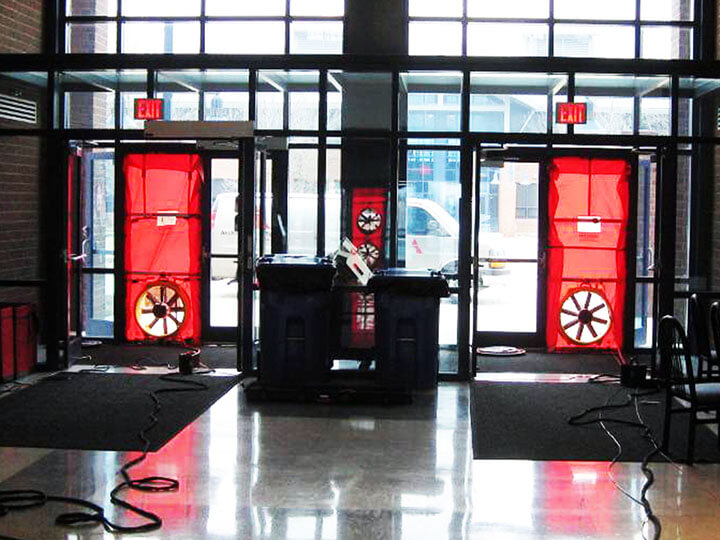
Temporary calibrated fans are installed in exterior openings. The building is then pressurized and/or depressurized through a series of pressure differences across the building envelope while airflow measurements are collected. These airflow measurements are used with the calculated envelope area to compute the building's air leakage rate.
What standards are commonly referenced for whole-building airtightness testing?
Whole-building airtightness testing is commonly performed in accordance with ASTM E779 or ASTM E3158 or USACE Air Leakage protocol (in the United States), depending on project requirements and applicable codes.
What does the test report include?
A typical report includes building test conditions, pressure measurements, airflow data, calculated leakage rates, compliance evaluation, and recommendations for remediation if air leakage diagnostics testing is performed.
What happens if a building does not meet the required airtightness target?
Air leakage diagnostic (qualitative) testing using various tools (smoke generators, infrared thermography cameras) can help identify sources of air leakage locations. Corrective air sealing measures may then be implemented, followed by retesting to verify compliance with project or code requirements. Note that at substantial completion, typically the air barrier membrane and it’s transitions between assemblies are mostly covered up and inaccessible (e.g. behind cladding or drywall). Qualitative testing is best performed at early stages of construction to generally understand where workmanship deficiencies are. This is a more proactive approach than waiting till the very end of construction, when potential repairs are much more difficult, costly, and time consuming.
Which building types can be tested using ASTM E779?
ASTM E779 can be used for any building archetype and can include wide range of building types, including commercial, institutional, healthcare, educational, multifamily, and industrial facilities. However it’s standard procedures do no provide clarity or flexibility with some of the challenges that are more specific to larger buildings, that ASTM E3158 and USACE tries to handle.
How does airtightness testing support energy code compliance?
Recent energy codes (e.g. IECC 2021, IECC 2024, ASHRE 90.1 2011) increasingly require whole-building air leakage testing as a means of verifying envelope performance and demonstrating compliance with air barrier requirements.
Can testing identify the exact location of air leaks?
ASTM E779 quantifies total air leakage. When combined with diagnostic testing (ASTM E 1186, also know as a qualitative test) with tools such as smoke testing, infrared thermography, or targeted investigations, teams can identify specific leakage pathways and prioritize repairs.
Related Links
Air Barrier Testing | Building Air Leakage Testing and Consulting Services | Intertek
With Intertek’s Whole Building Air Barrier Solutions, building owners can be assured that their building enclosure is airtight, meeting required performance targets required by code and high-performance building standards.
Knowledge Center
Building Health & Wellness: An Overview of Services
Acoustical Testing & Consulting Resources
Remote Pre Inspections for NFPA 80 / 101
Protek - Safety. Everywhere. Every Day
Fire Doors 101: Your Guide to Testing and Certification - Webinar Recording
Tornado Testing & Certification Requirements - Webinar Recording
Plumbing Products Testing & Certification - Webinar Recording
The Evolving Code Evaluation Process White Paper
Proposition 65 & the Furniture Industry Webinar Recording
Why Planning for FCC Certification is Key to Success in the Door Hardware Industry White Paper