Regulate the energy performance of your building materials, products, and systems with precision thermal conductivity and resistance testing and NFRC Product Certification solutions
What is Thermal Conductivity Testing?
Thermal conductivity testing measures how effectively a material conducts heat, providing data used for product design, quality control, and regulatory compliance. This property is important for applications where heat transfer impacts safety, performance, or efficiency, such as electronics, insulation materials, and automotive components.
Why is Thermal Conductivity Testing Important?
Thermal conductivity and resistance testing helps manufacturers, designer, and project teams understand how building products manage heat transfer. Testing determines how well a material conducts heat, which helps show how products will perform in real-world thermal environments.
Materials with low thermal conductivity—such as insulation, foams, and wall systems—are designed to reduce heat transfer, helping maintain stable indoor temperatures and lower energy costs. Conversely, materials with high thermal conductivity, like metals or stone, are used strategically where heat dissipation or structural performance is required.
Accurate thermal conductivity data is also critical for meeting building codes and standards, such as ASHRAE, ASTM, and ISO energy performance requirements. It allows manufacturers to quantify R-values and U-factors, validate marketing claims, and demonstrate compliance with energy efficiency programs such as LEED, ENERGY STAR, or regional regulations.
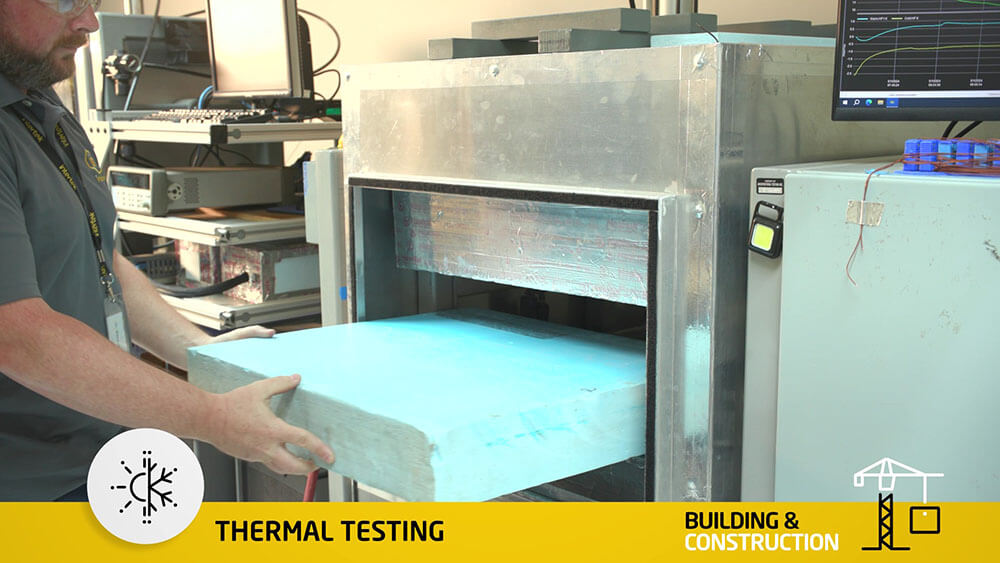
Intertek's Thermal Testing
How is Thermal Performance measured?
Thermal Transmission (U-Factor)
Determine the rate of heat transfer through your product or system.
Thermal Resistance (R-Factor)
Understand your product or system’s resistance to heat transfer.
Thermal Conductivity (k-Value)
Obtain data on the transmission of heat through your material.
Solar Heat Gain Coefficient (SHGC)
Measure the transmission of the sun’s heat through your material, product or system.
Visible Transmittance (VT or VTL)
Detect the level of transmission of the sun’s light through your material, product or system.
Condensation Resistance (CRF)
Test your system for the potential occurrence of condensation on the interior.
Temperature Cycling
Subject your product to accelerated weathering/ageing or extreme conditions.
Intertek's Thermal Conductivity and Resistance Testing Solutions
Intertek’s thermal testing and simulation services can support Energy Star Compliance, NFRC Certificationand local or federal energy code requirements. We offer thermal testing and simulation capabilities for materials, components, products, and systems, including fenestration products such as windows, doors, skylights, and curtain walls.
With our comprehensive capabilities, we can provide technical reports for performance thermal testing and thermal simulations of materials or components, data collection and statistical analysis, and authoritative advice on general principles that may be affecting your results.
NFRC Product Certification
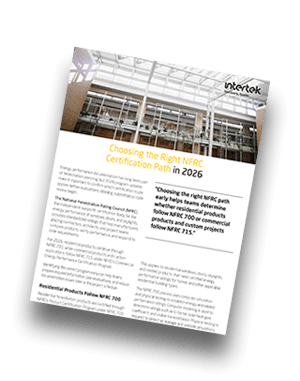
Choosing the Right NFRC
Certification Path in 2026
The National Fenestration Rating Council (NFRC) administers certification programs for the energy performance of windows, doors, skylights, and other fenestration products. NFRC certification provides standardized ratings that help manufacturers, glazing contractors, architects, and project teams compare products, verify performance, and respond to code requirements.
Residential products continue through NFRC 700, while commercial products and custom applications are addressed under NFRC 715, NFRC’s Commercial Energy Performance Certification Program. Identifying the correct program early can help teams plan for evaluations, labeling, submittals, and code documentation.
Key program considerations include:
- NFRC 700 for Residential Products: Uses computer simulation and physical testing to establish energy and related performance ratings, including U-factor, solar heat gain coefficient, and visible transmittance. Physical testing is required for air leakage and to validate simulations.
- LEAFF Methodology: Linear Energy Analysis for Fenestration uses a trendline approach for product certification and is tied to condensation index implementation.
- NFRC 715 for Commercial Products: Includes paths for standard product certification and custom project applications. The standard product path applies to repeatable commercial product lines used across multiple projects.
- NFRC 715 Custom Project Path: Applies to job-specific commercial conditions, including non-standard assemblies that are not feasible to test physically for a unique fenestration system. Physical validation is not required because the certification is tied to a one-off project and the certificate cannot be reused.
- Custom Project Ratings: Products under the Custom Project Path are rated for U-factor, solar heat gain coefficient and visible transmittance. Condensation index may be included if applicable. Air leakage is not rated under this path.
Obtaining NFRC certification can result in certified ratings, a program label for customer verification, and listing in the NFRC Certified Product Directory or, for applicable commercial projects, a project-specific label certificate tied to the building address.
NFRC requires review by an accredited third-party agency. The selected inspection agency reviews submitted simulations and physical test reports, as applicable, to confirm compliance and support certification.
Computer Simulations & Physical Testing
Computer simulations and physical testing are used to support NFRC certification, but the requirements depend on the product type and certification path.
For residential products under NFRC 700, computer simulations are used to determine ratings such as U-factor, solar heat gain coefficient and visible transmittance. Physical testing is used to validate simulations, and air leakage testing is required.
For commercial products under NFRC 715, requirements depend on whether the product follows the standard product path or the custom path. Standard commercial product certification may require simulations and validation testing. Custom project certification is tied to a specific building and does not require physical validation because the certificate cannot be reused for another project.
There is no specific order required for computer simulations and physical testing to be performed. If expectations for product performance are unclear, simulations are often completed first so design modifications can be made before fabrication of physical test units.
Products that benefit from Thermal Testing
Test Equipment
Guarded Hot Box (GHB)
Solar Calorimeter (SOL)
Large Diameter Integrating Sphere (LDIS)
Environmental Chambers (EC)
Heat Flow Meters (HFM)
Computer Simulation Software (W6 / T6)
Related Links
Featured on #YoullBeAmazed

See this post on LinkedIn or learn more about our You'll Be Amazed campaign.

26 Jun 2026
Choosing the Right NFRC Certification Path in 2026
How Manufacturers and Project Teams Can Prepare for NFRC 700 and NFRC 715 Updates

Service Spotlight - WalkIn Cooler Services
Knowledge Center
Building Health & Wellness: An Overview of Services
Acoustical Testing & Consulting Resources
Remote Pre Inspections for NFPA 80 / 101
Protek - Safety. Everywhere. Every Day
Fire Doors 101: Your Guide to Testing and Certification - Webinar Recording
Tornado Testing & Certification Requirements - Webinar Recording
Plumbing Products Testing & Certification - Webinar Recording
The Evolving Code Evaluation Process White Paper
Proposition 65 & the Furniture Industry Webinar Recording
Why Planning for FCC Certification is Key to Success in the Door Hardware Industry White Paper

Upcoming Tradeshows & Events
Resources