
IEC 61508 Explained
14 Oct 2026
Why Functional Safety Still Matters Across Modern Industry
From industrial automation and robotics to energy systems, transportation infrastructure, and process plants, modern industry depends heavily on electrical, electronic, and programmable electronic systems. These technologies improve efficiency, productivity, flexibility, and connectivity. However, they also introduce new forms of risk. When safety-related control systems fail, the consequences can be severe:
- Injury or loss of life
- Environmental harm
- Major financial losses
- Production downtime
- Regulatory action
- Reputation damage
Widely recognized as the foundational international functional safety standard, IEC 61508 was developed to help organizations manage these risks systematically. The standard provides a structured lifecycle framework for achieving and maintaining the functional safety of Electrical/Electronic/Programmable Electronic (E/E/PE) safety-related systems.
Although often viewed as highly technical, IEC 61508 is ultimately about reducing risk in a systematic, defensible and repeatable manner – ensuring that safety functions will perform when required. As industrial systems become increasingly autonomous, software-driven, and interconnected, the importance of IEC 61508 and broader Functional Safety standards continues to grow.
What IEC 61508 Actually Covers
IEC 61508 is a generic functional safety standard applicable across multiple industries. Rather than focusing on a single product sector, it establishes broad principles for managing safety-related systems throughout their lifecycle. The standard addresses:
- Hazard and risk assessment
- Safety lifecycle management
- Safety requirements specification
- Hardware reliability
- Software development
- Verification and validation
- Functional Safety Assessment (FSA)
- Competence and independence
- Operation and maintenance
- Modification and decommissioning
The standard itself is divided into 7 parts. Parts 1-3 contain the core normative requirements, while Parts 4-7 provide definitions, guidance and worked examples that support their application.
Part 1 – General Requirements
Defines the overall safety lifecycle, functional safety management, documentation, competence, verification, validation and functional safety assessment requirements.
Part 2 – Hardware Requirements
Defines requirements for E/E/PE safety-related system hardware, including hardware safety integrity, architectural constraints, failure rates, diagnostic coverage and random hardware failure management.
Part 3 – Software Requirements
Defines requirements for the software safety lifecycle, including systematic capability, software development, verification, validation, testing and software safety integrity.
Parts 4-7 – Definitions, Guidance, and Examples
These parts support the application and interpretation of Parts 1-3:
- Part 4 – Definitions and abbreviations.
- Part 5 – Examples of methods for determining safety integrity levels.
- Part 6 – Guidelines for applying Parts 2 and 3.
- Part 7 – Overview of techniques and measures used in functional safety.
This structure is important: Parts 1-3 tell you what must be achieved, while Parts 4-7 help you understand and apply those requirements in practice.
Functional Safety Is About Risk Reduction
At its core, IEC 61508 is a risk-based standard focused on reducing hazards to a tolerable and manageable level. The objective is not to eliminate all risk entirely – something that is rarely achievable in complex industrial environments – but to ensure that risks are reduced systematically through appropriate protective measures, safety functions, and lifecycle controls.
Functional safety typically becomes necessary when:
- Hazards cannot be adequately eliminated through inherently safe design alone
- Additional layers of risk reduction are required
- Safety functions depend on electrical, electronic, programmable, or automated control systems
- Failure of a control system could result in dangerous consequences
Examples of safety functions may include:
- Emergency shutdown systems
- Burner management systems
- Safe Torque Off (STO)
- Pressure protection systems
- Gas detection systems
- Overspeed protection
- Safety interlock systems
IEC 61508 provides the structured framework for specifying, designing, validating, operating, and maintaining these functions so that they achieve the required level of safety integrity throughout the system lifecycle.
Understanding Safety Integrity Levels (SIL)
One of the most widely recognised concepts within IEC 61508 is the Safety Integrity Level (SIL). A SIL defines the level of risk reduction required from a specific safety function in order to reduce risk to a tolerable level.
IEC 61508 defines four discrete SIL levels:
- SIL 1 – Lowest level of risk reduction
- SIL 2 – Moderate risk reduction
- SIL 3 – High risk reduction
- SIL 4 – Highest level of risk reduction
Critically, a product being described as “SIL capable” or “SIL certified” does not automatically mean the final safety function achieves that SIL target. The achieved SIL depends on how the complete safety function is specified, integrated, implemented, operated, and maintained within the application.
Achieving a SIL target therefore requires far more than selecting certified hardware or software components. It requires:
- Proper hazard and risk analysis
- Correct safety function specification
- Appropriate system architecture
- Reliable diagnostics and fault handling
- Verification and validation activities
- Competent personnel and independent review
- Effective Functional Safety Management throughout the lifecycle
This is one reason why IEC 61508 places such strong emphasis on lifecycle governance, competence, documentation, and systematic risk management – not simply component certification alone.
Why IEC 61508 Remains Highly Relevant
Many sector-specific standards are built upon IEC 61508 principles.
Examples include:
- IEC 61511 (process industry)
- IEC 62061 (machinery)
- ISO 13849 (machinery control systems)
- ISO 26262 (automotive)
- IEC 61800-5-2 (drives)
- IEC 61513 (nuclear)
This makes IEC 61508 highly influential even where it is not directly applied. Its importance is increasing further due to emerging technologies. As systems become more complex, organizations require stronger lifecycle discipline and more robust safety governance, and IEC 61508 continues to provide the foundation for that discipline.
Final Thoughts
IEC 61508 remains one of the most important international standards for managing functional safety in modern industry. Its value extends far beyond calculations or certification activities. The standard provides a disciplined framework for managing risk systematically throughout the entire lifecycle of safety-related systems.
As automation, software, connectivity, and autonomy continue to expand, the importance of structured functional safety governance will only increase. Organizations that invest in strong lifecycle management, competence, verification, and independent assessment are far better positioned to reduce operational risk, improve reliability, and build stakeholder trust.

You may be interested in...
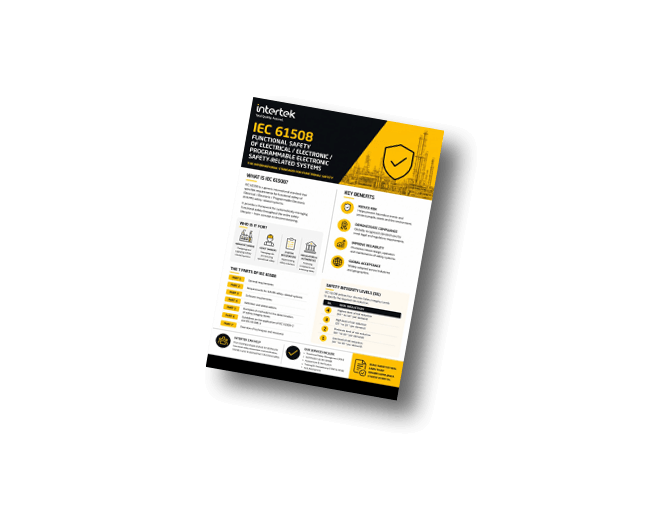
IEC 61508: The International Standard for Functional Safety Overview
Download our IEC 61508 Functional Safety Overview infographic for a concise visual guide to the standard's safety lifecycle, Safety Integrity Levels (SIL), and core requirements.

Functional Safety Testing & Certification
From early design stages through to production, our modular FS solutions provide flexible options for manufacturers, and our FS Mark provides stakeholders with visibility for products they purchase, install, or utilize in operations.